
PLEASE NOTE, THIS POST MAY INCLUDE AFFILIATE LINKS, MEANING THAT IF YOU CLICK ON A LINK AND MAKE A PURCHASE, I’LL RECEIVE A SMALL COMMISION. THIS WILL COME AT NO COST TO YOU.
Travel is a sensory experience. We travel to see new things, taste new things, smell new things, and touch new things. Although seeing and tasting take the travel sensory lead, hearing is often neglected. As I listen to the melody played by the hollow bamboo on the Hana side of Haleakala National Park, on Maui, I vow never to neglect the sense of hearing again.
The Summit District
The most popular section of Haleakala National Park is the Summit District. There are two Visitors centers, hiking trails, and scenic overlooks. The entrance is located in Maui’s Upcountry. The sought-after activity at this section of Haleakala National Park is to see the sunrise on the summit. To see the sunrise, you must make a reservation or join a tour.
The Summit section of Haleakala National Park is above my Pulmonary Hypertension elevation limit. One morning, Shannon headed to the park to get a stamp while I spent time at a safe elevation in Maui’s Upcountry.
Desiring to spend a meaningful amount of time together in this Hawaii National Park, we made the Hana side of Haleakala National Park a priority.
Kipahulu District
Taking a road trip on Maui’s famous Road to Hana is a popular Maui activity. Most embark on a one-day road trip and, due to a lack of time, miss out on seeing the Hana side of Haleakala National Park. Part of our plan for enjoying The Road to Hana included a two-night stay in Hana Town. A stay affords a significant amount of time to explore the park.
Click here to read Tips for Enjoying The Road to Hana
Visitors Center
Arriving at the park early ensures a space in the parking lot. I read that the park gets busy and crowded, but during our two-day visit, we only encountered a handful of visitors. The Visitors Center is light on exhibits. You are here for the nature. The views from the porch were outstanding.
The National Park Passport Stamp for the Hana side of Haleakala Park is located inside the Visitors Center.

There are no restrooms on the trails. Use the bathroom before you start your hike. There is no food or drinks for purchase at the park. A water refill station is located near the restrooms. The tropical environment gets hot and humid. Be sure to hydrate.
Kuloa Point Trail
If you are short on time and/or want an easy trail, Kuloa Point Trail is a solid option. The trail is a well-maintained 0.5-mile loop. The area is an archeological site, and you will see ruins as well as a reconstructed meeting house.
If you want to see black sand in Hawaii, the loop provides a glimpse.

The highlight of the trail is the Ohe’o Gulch. Here, you encounter vibrant green vegetation surrounding an impressive formation of rocks, embellished with a waterfall. This site is picture-perfect.

When prioritizing Hana road-trip attractions, the Kuloa Point Trail at the Hana side of Haleakala National Park is worth adding to your schedule.
Kahakal Trail
This is an easy 0.3-mile trail that leads to the park’s campground. We did not walk this trail.
Pipiwai Trail
Pipiwai Trail is a sought-after hike on the island of Maui. This 4-mile out-and-back hike is considered too time-consuming for one-day road trippers. If spending multiple days in Hana, it is an ideal way to spend a morning.

This hiking trail on the Hana side of Haleakala National Park is rated a moderate challenge. It is one continuous straight path that steadily climbs to Waimoka Falls.
The Banyan Tree
Banyan trees never cease to amaze. Old and wise. Their branches reach up, dive down, and intertwine. It is an ever-growing tree.

Whenever we encounter a banyan tree we take time to stop and admire its design.
Makahiku Falls
Refreshing water droplets splash against our skin as we look over the side of the bridge. The Makahiku Falls cascade down into gorgeous blue-green pools. This scene is what I imagined Hawaii would look like.

We linger at the falls until the harsh sun nudges us into the bamboo forest’s shade.
Bamboo Forest
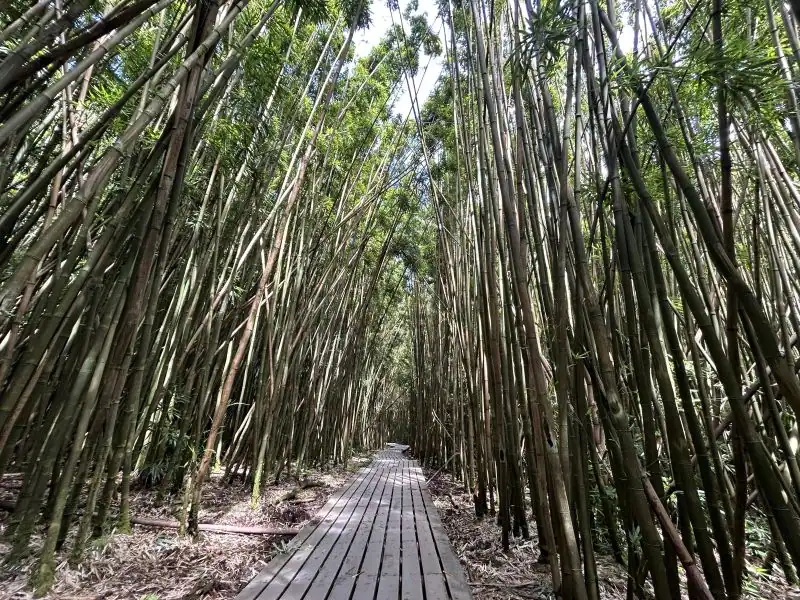
Rocks and dirt turn into wooden boards as we enter Haleakala National Park’s Bamboo Forest. It’s our first bamboo forest, and we are the only humans in sight, climbing the boardwalk trail. As a breeze whispers through the bamboo tunnel, the stalks collide. The result is a hollow, multi-pitch melody. Nature is singing a beautiful, peaceful lullaby. It is a sound I have never heard. A familiar thrill rises in my being. I am experiencing something new. I am hearing this music for the very first time. We take our time moving through the bamboo forest.

Reason one is that we want to savor the hike. This is the only activity we planned for today, we have nowhere else to be. Reason two is that the constant ascension is affecting my Pulmonary Hypertension. I have to stop a few times to take a break.
The Bamboo Forest is one mile into the hike. Day road trippers will often hike the Pipiwai Trail to the bamboo forest and then hike back down. I understand, the waterfalls are great, but for us, the bamboo forest was the highlight of the hike.
Waimoku Falls
The goal of the hike on the Hana side of Haleakala National Park is to reach Waimoku Falls. Though the trail never felt crowded, we encountered the most hikers at the falls. This is the trickiest part of the hike. You have to scramble through large rocks to reach the waterfall lookout. It’s not hard as long as you pay close attention to where you step. The opening in the vegetation is narrow. The waterfall lookout spot can only accommodate a few bodies at a time.

Visitors formed a friendly, polite queue, allowing everyone a chance to appreciatie the view.
Butterflies glided across the trail throughout our hike. We also got a peek at some other wildlife.

Conclusion
Kuloa Point Trail packs a lot into a 0.5-mile loop.

You will see the beach, a waterfall, and learn some history. It’s a good option for people who need an easy trail or are short of time.
I prefer loop trails over out-and-back trails, but I didn’t mind having a second chance to hike through the bamboo forest and get splashed by Makahiku Falls on the Pipiwai Trail. I would rate the Pipiwai Trail moderate to challenging. It depends on your hiking skills. The trail is well-maintained and logistically easy, but it involves hiking a steep, consistent incline. The hike should take a minimum of 2 1/2 to 3 hours. That is without stopping to rest and/or take photos. We arrived at the park at opening, and the Pipiwai Trail took a full morning. I would only recommend the trail if you have a full day to spend in Hana Town.
I’m glad we decided to spend a few days in Hana and had the luxury of time to explore the Hana side of Haleakala National Park. The park’s scenery is iconic Hawaii. This National Park should not be missed.

https://www.shakaguide.com/?via=sarah
Find A Great Place to Stay in Hana-Maui-Hawaii


Comments
4 responses to “Visiting The Hana Side of Haleakala National Park-Maui-Hawaii”
The Banyan trees are so impressive in this area. We missed the Bamboo forest hike though, which looks like such a tranquil area.
We enjoyed seeing the Banyan Tree on the Pipiwai Trail and another in Hilo on The Big Island. Banyan trees are one of my favorite things to see during a visit to a tropical location.
The two-night stay in Hana Town to allow time to explore the park was an excellent decision. The hiking looks amazing and even better that you were not rushed.
I’m happy we got to spend an significant amount of time slowly walking through the bamboo forest.