
PLEASE NOTE, THIS POST MAY INCLUDE AFFILIATE LINKS, MEANING THAT IF YOU CLICK ON A LINK AND MAKE A PURCHASE, I’LL RECEIVE A SMALL COMMISION. THIS WILL COME AT NO COST TO YOU.
Palm trees sway. A turtle snoozes in the sand. The sound of rolling waves crashes against the shoreline. For us, this Hawaii National Park site is a calming refuge from the hustle and bustle of everyday life. It’s not just any refuge, however. The Pu’uhonua o Honaunau National Historical Park, located near Kona on The Big Island, is also a sacred space.

The signs appear the moment we enter Pu’uhonua o Honaunau National Historical Park. The signs welcome visitors and remind them that this National Park Site is sacred. Unlike Kaloko-Honokohau National Historical Park on The Big Island, swimming and recreational activities are allowed at Pu’uhonau o Honaunau. The park is focuses on history and culture. If you desire to snorkel, swim, sunbathe, canoe/kayak, or even camp, there are State Parks on either side of the National Park.
Click here to read about our visit to Kaloko-Honokohau National Historical Park
The History
Before King Kamehameha’s unification, the islands were ruled by independent chiefdoms. These chiefdoms were often at war, operating under a cast system composed of royalty, priests/experts, commoners, and outcasts. To maintain social order and religious purity, a strict set of laws was enforced. Breaking a law was often punishable by death. Women and Men ate separately. Women were not allowed to consume bananas, coconuts, or pork (sacrificial foods). Commoners violated the kapu (set of laws) if they looked directly at a Chief. If sentenced to death, you could save yourself by fleeing to one of the islands’ sacred refuges. There, a priest could absolve you of your transgression, and you began your rehabilitation.
Though there were multiple refuges in Hawaii, Pu’uhonua o Honaunau was the most well-known.
Due to the wall that surrounded the land, this sacred place in Hawaii also served as a sanctuary for children, the elderly, and other non-combatants during Chiefdom wars.
The Stamp and Film
After acquiring our National Parks Passport Stamp at the Visitors Center, we view the small exhibit area, then sit on one of the benches in the large, covered, open-air theater. The film ranks in my top 10 National Park films. It’s moving and teaches a complex political and spiritual structure in a way that makes it easy to understand. If you don’t plan on visiting the park anytime soon, I highly recommend watching the movie on the National Park Service website.
Hale o Keawe Temple
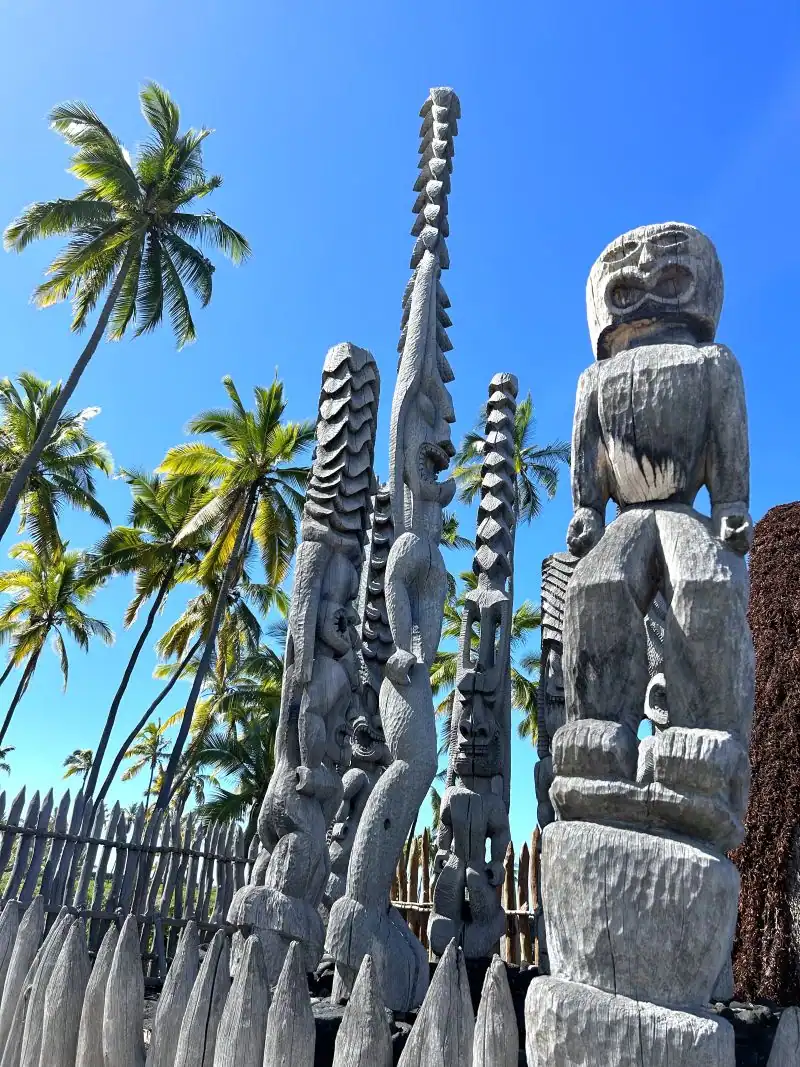
The main feature of the park is the Hale o Keawe Temple. The temple is surrounded by wooden statues, carved to represent the Hawaiian gods. This temple once held the bones of 22 Hawaiian Chiefs. Though the bones have been removed, it is believed that their spiritual essence remains.

Hawaiians continue to visit the temple to connect to the spirits of their ancestors. Just like you wouldn’t visit a cathedral and yell, scream, speak profanities, or disrupt the property, park visitors need to treat the temple with respect.

Exploring the Grounds
If you are looking for a landscape with blue skies, palm trees, and waves, the scenery at this National Park site is picture-perfect.

We wander the Royal Grounds. This was a completely neutral, non-violent space where warring chiefs worked out their differences.
Visitors can view the ruins of the lava rock wall as well as the lava rock ruins of Heiaus (temples).

The ruins are fascinating, but I highly recommend visiting Pu’ukohola Heiau National Historic Site for more information and history about Hawaii’s lava rock temples.
Click here to read about our visit to Pu’ukohola Heiau National Historic Site
Like Kaloko-Honokohau National Historical Park, there are also fish ponds that once provided food for those who lived in the sanctuary.
One area gave examples of what everyday life was like at Pu’uhonua o Honaunau.

Even though this park’s main purpose is to teach history and culture, we did encounter some wildlife.

Hiking
This National Historical Park in Hawaii offers a hiking trail. The Coastal Trail is an out-and-back hiking path that takes approximately two hours. There is more history and nature to discover along the trail. We decided not to hike the trail. It was a hot and very bright sunny day, and The Coastal Trail offers limited shade.
Things to Know
This National Historical Park Site is free to visit.
There are restrooms at The Visitors Center and a picnic area with portable toilets.
Along with the film, ranger talks take place in the theater space.
We spent about three hours at the park. If you add a hike on The Coastal Trail, you could easily spend a half-day or more.
Conclusion
Fellow guests at the park took the sacred space seriously, making exploration a quiet, relaxing, and reflective experience. If you enjoy a combination of history, culture, and nature, a visit to Pu’uhonua O Honaunau National Historical Park should be on your Hawaii National Parks List.
Find a Great Place To Stay on The Big Island


Leave a Reply