
PLEASE NOTE, THIS POST MAY INCLUDE AFFILIATE LINKS, MEANING THAT IF YOU CLICK ON A LINK AND MAKE A PURCHASE, I’LL RECEIVE A SMALL COMMISION. THIS WILL COME AT NO COST TO YOU.
Cue the Jaws theme. It’s playing in my head as we approach the Nahuku Lava Tube. The group ahead of us exits the tube, but a family of 12 barrels down the path behind us. As their boisterous cries get closer, we realize we have about ten minutes with the lava tube to ourselves. We take all of the pictures. We examine the walls as we step around small puddles. Goal achieved. Even if the alone time is brief, arriving at the lava tube first thing in the morning is worth it. It’s a great start to our full day at Volcanoes National Park.

If visiting Hawaii’s Big Island, a stop at Volcanoes National Park is a must. Though many visitors arrive with the hopes of seeing an eruption, it is not a guarantee. Lava or no lava, the park as a whole is a spectacular, intriguing geological wonder.
We were fortunate enough to have a full day and a half to spend at Volcanoes National Park. During our half day at Volcanoes National Park, we visited the spots close to the Kilauea Visitor Center.
Click here to read about our Half Day at Volcanoes National Park
After grabbing a latte at Coffee on The Rim, located in the Volcano House Hotel, and getting our first sweeping view of the day of Kilauea Crater, we settle into our rental car for a full day at Volcanoes National Park.
Nahuku Lava Tube
One of the most popular and thus most crowded features of Volcanoes National Park is the Nahuku Lava Tube. My research reveals that the best plan for beating the crowds is arriving first thing in the morning.
From the visitor center, Nahuku Lava Tube is a quick 6-minute drive. We have the short path to the lava tube to ourselves.

During the day, the lava tube parking lot fills up quickly. If it’s full, you can park at the Kilauea Ik Overlook parking lot.
Created by a river of molten lava, crowded or not, Nahuku Lava Tube is a marvel. It’s enormous
compared to the lava tube we visited on the Road to Hana in Maui. The sun was up, so we were able to explore the famous lava tube sans flashlight. It is similar to traversing a cave, but with a distinctive tube design.

As the large family entered the tube, the kids exclaimed,
“Wow, this is cool!”
I wholeheartedly agreed, nature is cool.
One end of the lava tube has an easy ramp entrance.

The other side of the tube requires climbing stairs.

Most of the park is comprised of a wide landscape of lava rock. The paths to and around the Nahuku Lava Tube are filled with lush green vegetation. The setting as a whole is magical.
Feeling accomplished, we set off on Crater Rim Drive to continue our full day at Volcanoes National Park.
Crater Rim Drive and Chain of Craters Road
If your plan is to drive through Volcanoes National Park and see the major attractions, you will take Crater Rim Drive and then turn onto Chain of Craters Road around the Devastation Trail area.

Full disclosure, if you scroll to the bottom of this page, you will find a link to the Shaka Guide Audio Tour website. I am an affiliate, but I signed up to be an affiliate because we love using the tours during our travels.
As you drive along Crater Rim Drive and Chain of Craters Drive, you can follow the park map, but the signs are easy to drive by, and you aren’t necessarily sure where some of the map spots are. You will drive and drive and drive along roads bordered by vast stretches of black and grey lava rock. Shaka Guide will tell you when you pass an area marked on the map and why that area is significant.

Based on the tour information, we could drive by an area or pull over to the side to investigate further. Without good insight or information regarding what to stop and see along Crater Rim Drive and Chain of Craters Road, it seemed most park visitors drive through the park and only stop at the main attractions. At many of the stops, it felt like we had the park completely to ourselves.

At some of the stops, you will see former lava flows.

Some areas are safe to walk, but there are places where the hardened lava flow can cause the surrounding ground to collapse. There are signs posted at the dangerous areas. Always obey park signs.
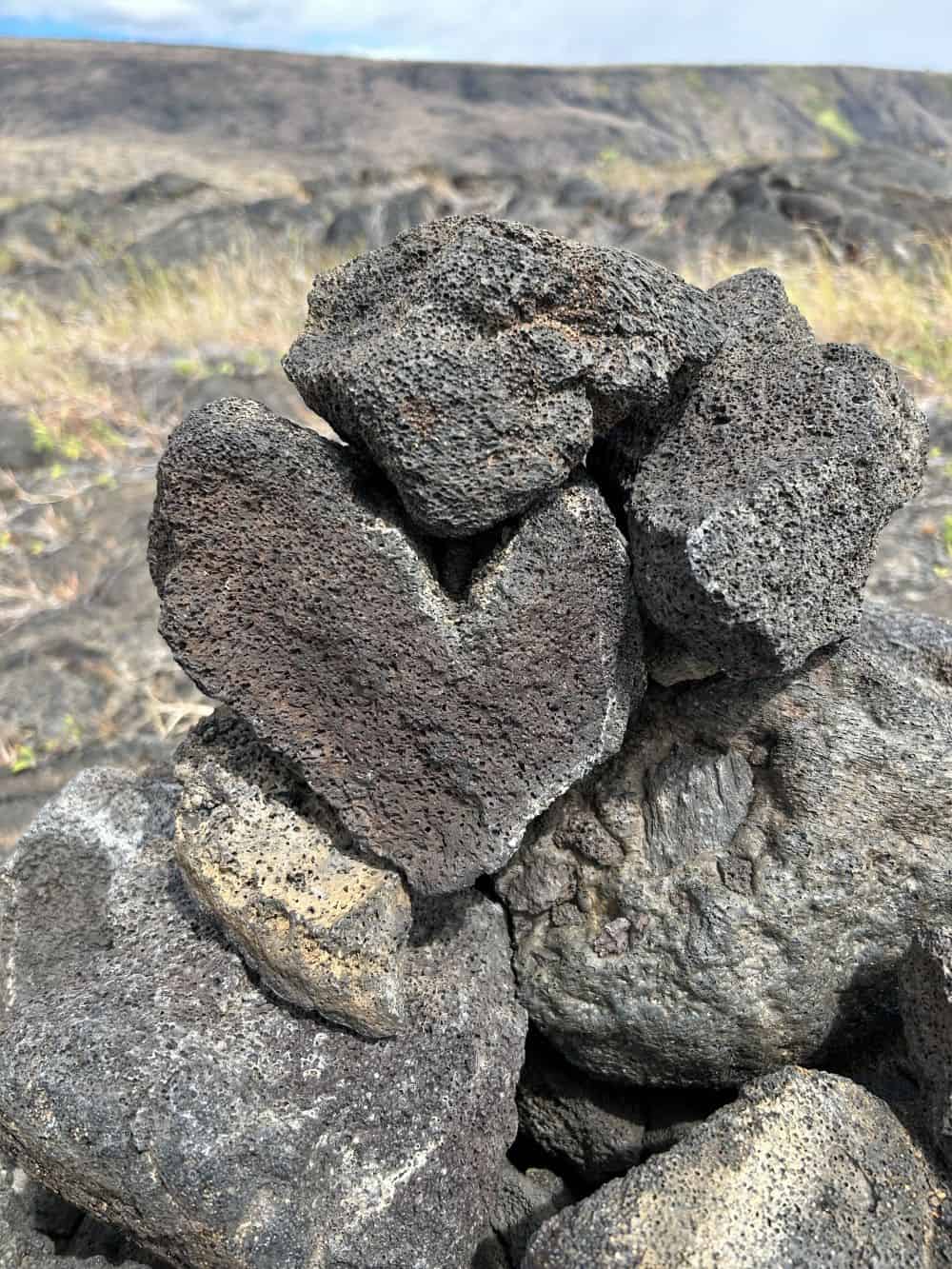
The patterns carved by lava are captivating natural art.


Due to the never-ending rocky landscape, I’m thrilled by any tree, flower, or plant growing up from the nooks and cracks.


Between stops, Shaka Guide provides informative science details and stories involving the history and culture of the park and Hawaii.
The luxury of spending a full day at Volcanoes National Park is that we can make frequent stops knowing we still have plenty of time to visit the major attractions.
Pu’uloa Petroglyphs
If you don’t have the time or the desire to make multiple stops along the way, the drive from Kilauea Visitor Center to the Pu’uloa Petroglyphs takes 30 minutes. Part writing, part art, I love examining petroglyphs.
You will have to walk over some lava rock to reach the easy, flat, boardwalk, trail. There is no shade on the trail, so be sure to wear sun protection and carry water.

When people think of petroglyphs, they envision drawings of animals and people. The Pu’uloa
Petroglyphs are a series of dots and circles. Though interpretations vary, the main consensus is that the petroglyphs were used to note births and keep track of family history.

I found my favorite rock of the entire trip on the Pu’uloa Petroglyph Trail.

Even if you only walk a short length of the trail, seeing this historic form of writing should be a must-stop.

Holei Sea Arch
The illusion that we are alone during our full day in Volcanoes National Park is broken when we enter the parking area for the Holei Sea Arch.
There are a lot of people visiting this natural wonder.

The benefits of a busy park attraction are the picnic tables and well-maintained pit-toilet bathrooms.

This area of the park was very windy, so secure your hat.
With rocks as far as the eye could see for hours, water is a welcome sight.
A short walk along the paved road leads to Holei Sea Arch.

If you want the perfect sea arch photo or video, patience is required. Everyone at the sea arch wants a picture. It was nice to see good park manners. On the day of our visit, no one monopolized the picture spot, the waiting was orderly, and people politely traded picture taking.
There is a reason this is one of the most populated sections of the park. Watching the waves crash against the dramatic black cliffs is splendid.

See the volcano crater and the lava tube for sure, but do not miss Holei Sea Arch. Eventually, the waves will cause the arch to crumble. It is the wonder and sadness of nature. We spend extra time staring out at the water.
We wander further down the road to get a better view of the curious oasis with palm trees waving in the breeze.

After successfully experiencing the Holei Sea Arch, we find ourselves in an unfamiliar situation. Since we are spending a full day at Volcanoes National Park, we have extra time.
Since the plan was to drive back the way we came, we made stops on our return to the park entrance.
Mauna Ulu Lookout

Pu’upua’i Overlook
The Pu’upua’i Overlook will give you a view of a gigantic cinder cone.


Devastation Trail
If you’d rather spend your day hiking instead of driving, there are plenty of trails at Volcanoes National Park. Since we had extra time, we made our way to Devastation Trail.
Different sections of the park were created by various volcanic activity. Devastation Trail highlights a 1959 eruption.

The parking lot of the trail is the first time we encounter wildlife in the park.
Ne ne are endangered Hawaiian geese.

Devastation Trail is a well-maintained one-mile loop. It showcases that when destroyed, nature will always strive to make a comeback.

The scenery along the trail was great.

The trail featured some neat, shiny, glittery, silvery rocks.

Some sections of the area are unsafe. Signs will instruct you where you can and cannot go.

The trail takes about an hour. I’m happy we had time to hike the Devastation Trail.
Kilauea Summit
Kilauea Summit was our last stop of the day. It offers sweeping views of the crater. The buildings at Kilauea Summit were closed during our visit and have since been demolished due to the destruction caused by the 2018 eruption.

It’s still worth a visit to get a different vantage point of the Kilauea Crater

Additional Information
We were fortunate enough to have a full day and a half day to spend at Volcanoes National Park. If you are only spending one full day at Volcanoes National Park, be sure to make time to see Kilauea Visitor Center, Sulphur Banks Trail, and Crater Rim Trail.
Restrooms are available at Kilauea Visitor Center, the Holei Arch area, the Devastation Trail area, and at several of the trail entrances and overlooks.
Food is only available at the Volcano House or outside of the park. If you spend a full day at Volcanoes National Park, I suggest having some food in your car. We packed protein bars and trail mix to snack on during the day and ended our day with dinner at The Rim restaurant (you must have a reservation). There are picnic tables located in certain areas.
Click here to read more about eating at Volcanoes National Park
Many people spend the day at Volcanoes National Park, enjoy the sunset on Crater Rim Trail, have dinner, then stargaze when the sky grows dark. Our evenings in the park were cloud-covered, so the night sky was not visible.
The volcano is not always erupting. You are not guaranteed to see lava during your visit. Lava is controlled by nature, not park staff.
Conclusion
With a unique volcanic landscape and fascinating features like a lava tube and Sulphur Banks, a visit to Volcanoes National Park on The Big Island of Hawaii should not be missed.

https://www.shakaguide.com/?via=sarah
Find A Great Place to Stay near Volcanoes National Park


